
Large-Envelope Parts: A Guide to Sourcing Large-Format CNC Machining
August 12, 2026
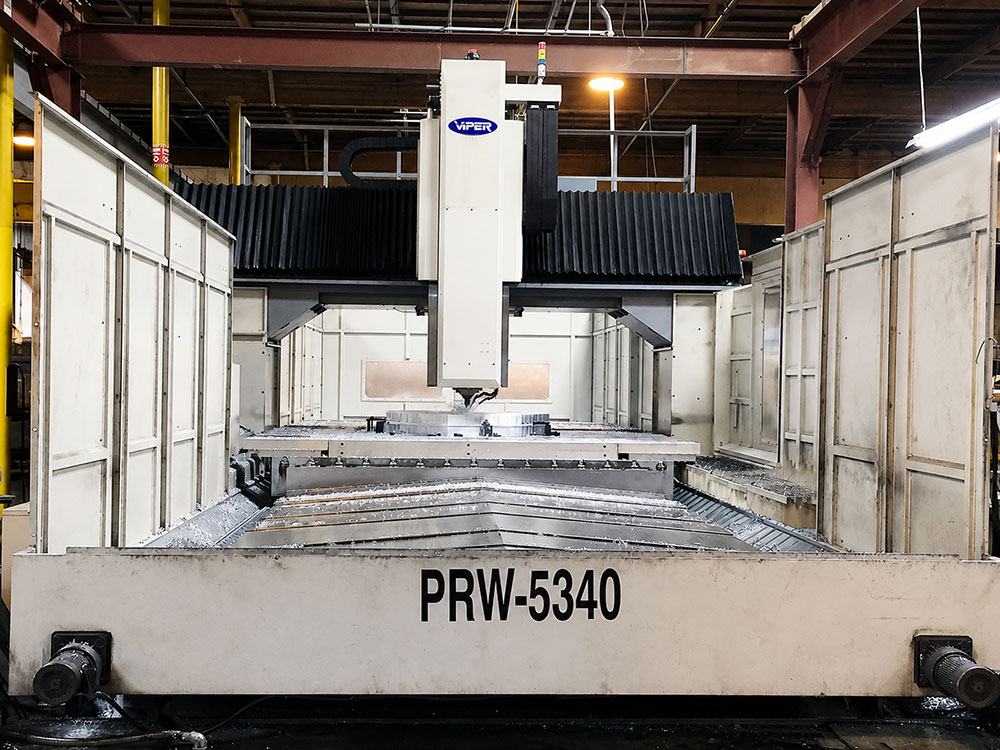

In precision manufacturing, large envelope parts are the components that will not fit on a standard machining center: satellite structures, vacuum chambers, defense-grade assemblies, and process-tool frames that arrive by forklift and need a crane to load. Very few shops anywhere can machine parts this large while holding tight tolerances, which is exactly why sourcing them is difficult. The part itself eliminates most of the supplier list before tolerances or price ever enter the conversation.
For buyers sourcing aerospace machining, space hardware, and defense work, the list gets shorter still, because the work is often export-controlled and has to stay with a domestic, ITAR-registered shop. This guide explains what makes large-format CNC machining hard, the capabilities that separate a true large-part shop from a general one, and the questions to ask before you award the work.
Why large-envelope machining is its own discipline
Machining a large part is not simply machining a small part scaled up. As components grow, several problems compound at once, and a shop has to solve all of them to deliver a part that holds spec.
● Machine capacity. The component has to physically fit. That means large machine travel, a table that supports the weight, and overhead crane capacity to load and reposition the part safely.
● Single-setup accuracy. Every time a large part is unclamped and refixtured, error creeps in. Shops that can machine more faces in a single setup, ideally with multi-axis equipment, hold accuracy that re-fixturing would destroy.
● Fixturing and rigging. Holding a multi-ton part rigid enough to machine to tight tolerances takes creative fixturing and experienced handling, not just a bigger vise.
● Thermal and dimensional stability. Large parts move with temperature, and a component this size usually cannot be carried into a climate-controlled inspection room at all. Repeatable results come from disciplined process control and a measurement method that accounts for the environment the part is actually inspected in.
● Metrology at scale. Verifying a part measured in feet, not inches, requires coordinate measuring capacity and method most shops do not have.
What to look for in a large-format machine shop
Machine envelope and crane capacity
Start here, because it is the fastest disqualifier. Confirm the shop’s machining travel, table size, and crane capacity against your part’s dimensions and weight. As a benchmark for genuinely large work, a capable large-envelope cell offers travel on the order of 205 x 135 x 42 inches with multi-ton overhead crane support. If a part exceeds what the shop can load and reach, nothing else matters.
Multi-axis CNC and single-setup capability
Ask how many faces of your part the shop can machine in one setup. Multi-axis CNC milling, turning, and boring let a manufacturer cut complex geometry without repeatedly re-fixturing a heavy part, which is the single biggest source of error on large components. The fewer the setups, the truer the part.
Material range
Large structural and process parts span aluminum, stainless, titanium, and exotic alloys, often within one program. A shop that runs the full range, with documented material certifications, spares you from splitting a project across vendors.
Welding, assembly, and integration
Many large parts are not single billets but weldments and assemblies. Look for AWS-certified welding and in-house assembly, so machining, welding, and buildup happen under one roof and one quality system rather than being handed between suppliers.
Large-part inspection and metrology
A large part is only as good as the proof that it meets print. Confirm the shop runs coordinate measuring inspection sized for big components, with First Article Inspection on new designs. Then ask how it inspects parts too large to fit a climate-controlled room, because most parts at this scale never will, and the answer separates a shop with real large-part method from one scaling up a small-part process. Documentation should be part of the deliverable, not an afterthought.
Quality certifications and domestic supply
ISO 9001:2015 is the baseline quality-system expectation, and material and process certifications should come standard with the part. For work that crosses into aerospace, space, and defense, a domestic shop keeps a heavy, expensive component close and shortens logistics on parts that are awkward to ship. Where the work is performed matters as much as how it is performed.
Controlled work and ITAR registration
If your part touches a defense article or technical data covered by the U.S. Munitions List, your machine shop has to be ITAR registered with the State Department before it can legally take the work. ITAR registration is not a quality certificate and it does not expire like one. It is an active registration the shop maintains, and it signals that the supplier handles controlled drawings, materials, and finished hardware under the right export-control discipline.
For a buyer, ITAR registration does two things. It opens the door to aerospace, space, and defense machining programs that a non-registered shop cannot quote, and it keeps controlled work inside the United States with a supplier that already understands the handling requirements. If your roadmap includes any defense or space work, confirm a shop is ITAR registered now rather than discovering a gap once a controlled program is on the table.
Industries that depend on large envelope parts
Demand for large-format precision machining concentrates where systems are physically large and failure is costly: aerospace machining and space structures, including space satellite structures and components, semiconductor vacuum chambers and process-tool frames, national-laboratory and research hardware, and energy and clean-technology equipment. In these sectors, dimensional accuracy on an oversized component often determines whether the larger system performs at all, and defense and space programs add the requirement that the supplier be ITAR registered.
Questions to ask before you award the work
- What are your machining travel, table size, and crane capacity, and can you handle my part’s dimensions and weight?
- How many faces of the part can you machine in a single setup?
- Which materials do you run in-house, and can you provide material certifications?
- Do you offer AWS-certified welding and in-house assembly for weldments and large assemblies?
- What is your inspection capability for large parts, and will I receive CMM and First Article documentation?
- Are you ISO 9001:2015 certified and ITAR registered, and where is the work performed?
Where IMT Precision fits
IMT Precision is built specifically for large envelope parts. From its Hayward, California facility, the shop offers a large-envelope machining cell with up to 205 x 135 x 42 inches of travel and 10-ton overhead crane support, multi-axis CNC milling, turning, and boring in aluminum, stainless, titanium, and exotic alloys, AWS-certified welding, assembly and integration, and CMM inspection with First Article Inspection. It is ISO 9001:2015 certified and recently completed ITAR registration, which extends its large-format capability to controlled aerospace, space, and defense programs, including space satellite structures and components. It manufactures large, complex components for aerospace and defense, space, semiconductor, energy, and national-laboratory customers.
That single-source capability, machining, welding, assembly, and validated inspection in one ITAR-registered shop, is what lets a buyer take an oversized component from CAD model to a finished, verified part without splitting it across vendors. It is a capability few shops on the West Coast can match.
Have a large or complex part in hand?
Upload your CAD files and IMT Precision will return an assessment of fit, tolerances, and lead time within 24 hours. Start your quote

Start Your Quote
Upload Your CAD Files and receive a response within 24 hours.


COPYRIGHT © 2026 IMTP