
Why Large-Envelope Machining Capacity Is Scarce on the West Coast
October 9, 2026
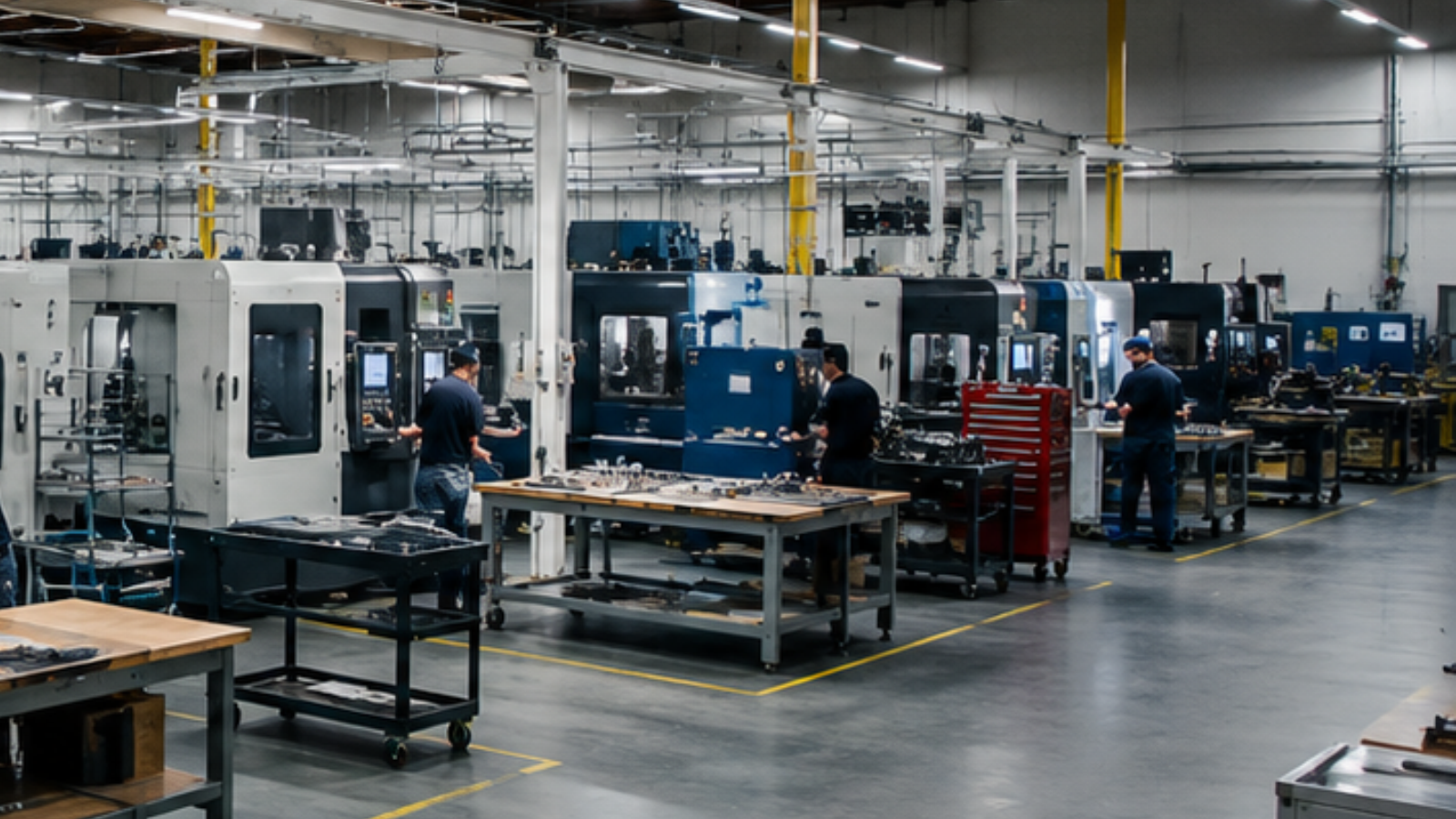

Explore the supply, equipment, infrastructure, and specialized workforce challenges that make large-envelope machining capacity increasingly difficult to secure across the West Coast.
Why large-envelope shops are rare
Most CNC capacity in the United States is built around parts that fit on a pallet. Machining centers with travels measured in tens of inches make up the bulk of the installed base, because that is where most of the work is. Parts measured in feet rather than inches are a different business.
Getting into that business means stacking commitments that compound. A large-travel machine is a major capital purchase before tooling, fixturing, and installation are counted. It needs a foundation designed for its weight and rigidity. It needs a building with the clear height and floor area to move a part the size of a car around it. And it needs a crane to get that part on and off the table. Each of those is expensive on its own. Together, they form a barrier most shops have no reason to cross, because the small-part market pays well enough.
On the West Coast, the barrier is higher. Industrial land in the major manufacturing corridors is scarce and costly, and buildings with heavy lifting capacity and high ceilings are in limited supply. A shop that wants to add a large-travel machine often has to find a new building first.
What crane capacity and floor loading actually constrain
Buyers tend to compare shops on machine travel, the X, Y, and Z figures printed on the capability sheet. Travel is the ceiling on what a machine can cut. It is not the ceiling on what a shop can make.
The practical limit is often the crane. A large part has to be lifted off the truck, flipped, set on the table, and moved between operations. If the shop's lifting capacity falls short of the workpiece plus its fixture, the machine's travel is irrelevant. Floor loading works the same way. A heavy casting or plate that cannot be staged safely near the machine becomes a scheduling problem before it ever becomes a machining problem.
Fixturing adds another layer. Large parts need large fixtures, and those fixtures take floor space, storage, and time to build. Shops that do this work regularly have learned to support a part without distorting it, which is harder than it sounds on a thin-walled panel or a long frame.
IMT Precision's Hayward, California facility shows how those pieces fit together. The 50,000 square foot shop runs a vertical mill with 201 by 134 by 42 inches of travel and a horizontal mill with 160 by 94 by 60 inches of travel, supported by a 10-ton overhead crane. The crane figure matters as much as the travel figures, because it decides which large parts the shop can actually handle.
The hidden cost of shipping oversized parts
When a West Coast program cannot find local capacity, the part goes elsewhere, and the quote from a distant shop can look competitive. What that quote usually leaves out is the trip.
Oversized components rarely ride on a standard pallet. They need custom crating, blocking, and bracing, and sometimes a flatbed or a dedicated truck. Loads beyond legal dimensions require permits and come with routing restrictions. Each of those costs lands on a freight invoice rather than the machining quote, and often on a different budget line entirely.
The trip adds time in both directions. Raw material or castings travel out, and finished parts travel back. If the part needs a secondary operation at another vendor, it travels again. A component sitting on a truck is a component that is not being machined, inspected, or installed.
Damage and re-inspection risk in transit
Freight cost is the visible part. The larger risk is what happens to the part on the way.
A finished surface can be damaged by a shifting crate, and large thin-walled structures can deflect if they are not supported correctly. Vibration and temperature swings over a long haul are a real concern for parts with tight flatness or positional requirements. When the component arrives, many programs will not accept it on the strength of the supplier's report alone. They re-inspect it, and on a large part that inspection is its own project, requiring the right equipment and, again, a way to lift and stage the part.
If something comes back out of tolerance, the question of where it went wrong is hard to answer. It could be the machining, the fixturing, the crate, or the truck. Every handoff between vendors and carriers adds a seam where accountability gets blurry.
Keeping the process steps under one roof removes many of those seams. IMT performs precision CNC machining, AWS-certified TIG and MIG welding, assembly and integration, and inspection in Hayward, under an ISO 9001:2015 certified quality management system. For parts too large for a conventional inspection room, the shop measures at an external QC area equipped with a 6-by-12-foot granite plate and a FaroArm Platinum with a 13.1-foot spherical measuring range, and each measurement ties back to a documented inspection report. The part is verified where it was made, before it goes anywhere near a truck.
What proximity to a program is worth on schedule
For programs based in California and across the West, distance also shapes how engineering problems get solved.
Large components tend to surface issues late: a datum that is hard to hold, an interface that does not match its mating part, a weld sequence that needs to change. When the supplier is a short drive away, an engineer can walk the floor, look at the part on the machine, and settle the question in an afternoon. When the supplier is across the country, the same conversation happens over photos and email, and the part waits.
Proximity also tightens the loop on revisions and prototypes. A design change on a large part often means a new fixture or a modified setup, and a nearby shop can absorb that change without a round trip.
The same logic extends to controlled work. IMT completed ITAR registration in June 2026, which allows the shop to be considered for defense and space programs where registration is a requirement. For West Coast aerospace and space programs, large-envelope capacity, in-house process steps, and that regulatory standing within driving distance make for an uncommon combination.
What buyers should ask
Large-envelope capacity is scarce for structural reasons. The machines, the buildings, the cranes, and the fixturing all cost more, and most shops can do well without them. That scarcity is why oversized parts so often leave the region, and why the true cost of that decision tends to surface late, on a freight invoice, in a re-inspection report, or in a schedule slip.
A buyer sourcing a large component can cut through the capability sheet with a few direct questions. What is the shop's lifting capacity, and can it handle the part with its fixture? How many setups will the part need, and on which machines? Where will it be inspected, and with what equipment? How many vendors will touch it before it ships, and how far will it travel?
Those answers narrow the field quickly. IMT Precision has spent three decades in Hayward building the capacity to answer all of them from one building.
Copyright © 2026 California Business Journal. All Rights Reserved.
For California Business Journal Disclaimers, go to https://calbizjournal.com/terms-conditions/.

Start Your Quote
Upload Your CAD Files and receive a response within 24 hours.

COPYRIGHT © 2026 IMTP